


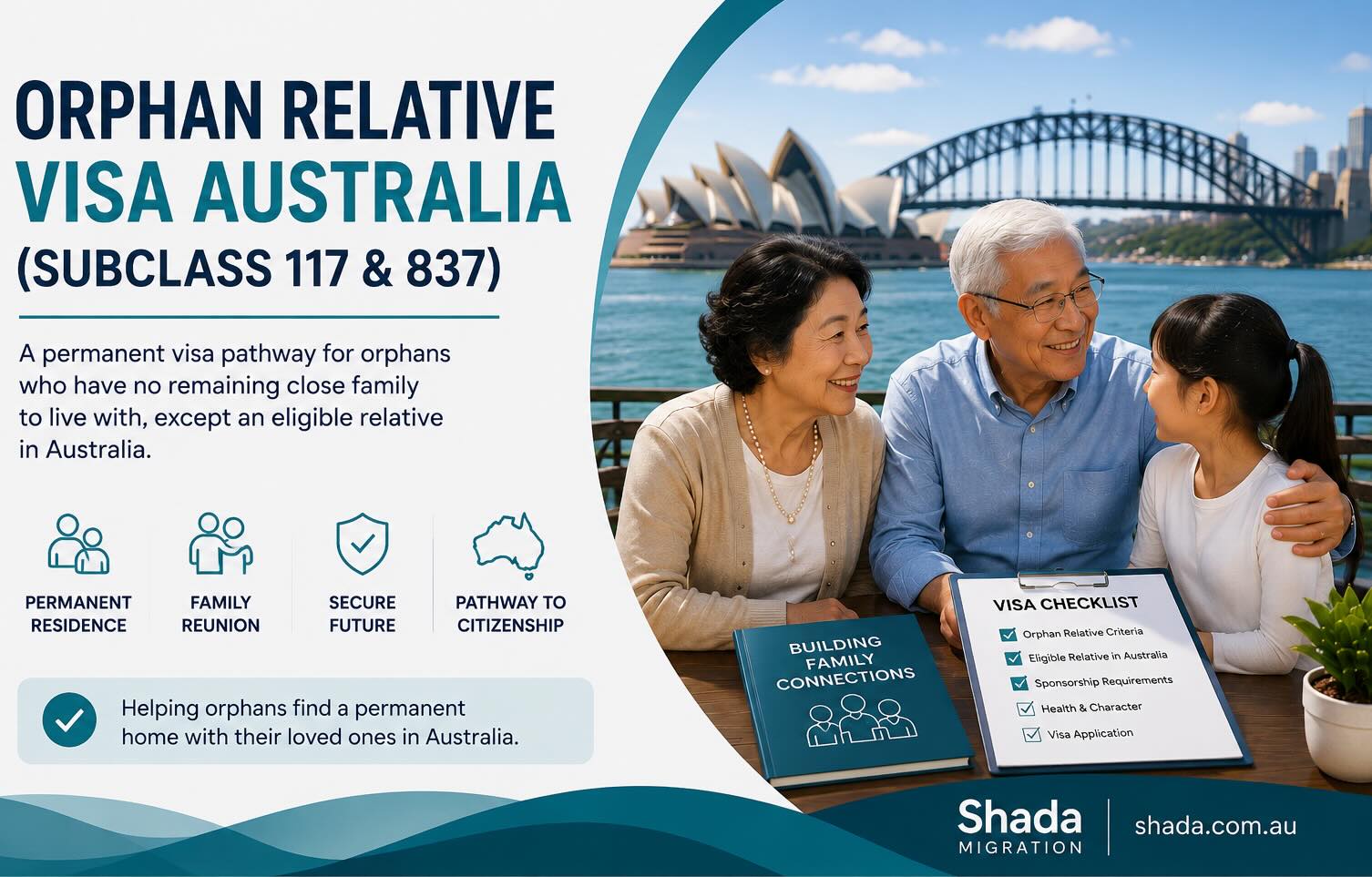
The Orphan Relative Visa allows certain children living outside Australia to migrate permanently to Australia and live with an eligible relative where their parents are unable to care for them.
This visa category is designed to provide a pathway for children who have lost their parents, whose parents are permanently incapable of caring for them, or whose whereabouts cannot be determined.
- Subclass 117 – Offshore application pathway
- Subclass 837 – Onshore application pathway
Both visa subclasses provide permanent residence and allow eligible children to live permanently with their sponsoring relatives in Australia.
- Permanent residence visa pathway
- Family reunification for eligible children
- Sponsorship by an eligible relative
- Access to education and healthcare
- Potential pathway to Australian citizenship
What is an Orphan Relative Visa?
The Orphan Relative Visa is a family migration pathway that enables certain children to live permanently in Australia with a relative who is willing and able to care for them.
The visa is intended for circumstances where the child cannot be cared for by their parents due to death, permanent incapacity or other recognised circumstances under Australian migration law.
The primary objective of the visa is to allow eligible children to be reunited with family members who can provide long-term care, support and stability.
Who Can Apply?
Applicants must satisfy a number of legislative requirements before an Orphan Relative Visa can be granted.
Child Applicant
The applicant must be an eligible child under the relevant visa provisions.
Eligible Relative
The child must have an eligible relative in Australia willing to sponsor and care for them.
Parental Circumstances
The child's parents must satisfy specific circumstances prescribed by migration legislation.
Health and Character
Relevant health and character requirements must be satisfied before visa grant.
Who is Considered an Eligible Child?
The visa is intended for children who are unable to remain under the care of their parents and who require long-term care from a relative in Australia.
The Department carefully examines the child's age, circumstances and family relationships when assessing eligibility.
Documentary evidence regarding identity, family relationships and guardianship arrangements is often required as part of the application process.
Who Can Sponsor the Child?
The child must generally be sponsored by an eligible relative who is an Australian citizen, Australian permanent resident or eligible New Zealand citizen.
The sponsoring relative must be willing to assume responsibility for the child's welfare, accommodation and support after arrival in Australia.
Sponsorship requirements should be carefully reviewed before lodging an application.
Parental Circumstances Requirements
One of the most important aspects of an Orphan Relative Visa application is establishing the circumstances relating to the child's parents.
The Department generally requires evidence demonstrating that the child's parents are deceased, permanently incapable of caring for the child, or that their whereabouts cannot reasonably be established.
These requirements are assessed carefully and often require substantial supporting documentation.
Health and Character Requirements
Applicants must satisfy relevant health and character requirements before the visa can be granted.
Additional documentation may be required depending on the child's age and circumstances.
Subclass 117 vs Subclass 837
The Orphan Relative Visa category contains two subclasses that provide permanent residence. The primary distinction is where the child is located when the visa application is lodged and when the visa is granted.
Subclass 117 (Offshore)
- Permanent residence visa
- Application generally lodged outside Australia
- Child generally outside Australia at visa grant
- Requires eligible Australian relative sponsor
- Long-term care arrangements required
- Permanent migration pathway
Subclass 837 (Onshore)
- Permanent residence visa
- Application generally lodged in Australia
- Child generally in Australia at visa grant
- Requires eligible Australian relative sponsor
- Long-term care arrangements required
- Permanent migration pathway
The appropriate visa subclass depends largely on the child's location and immigration circumstances at the time of application.
Benefits of the Orphan Relative Visa
Successful applicants receive Australian permanent residence and the opportunity to build a secure future within their family network in Australia.
Permanent Residence
Live permanently in Australia with an eligible relative.
Access to Education
Access Australia's education system and long-term educational opportunities.
Medicare Access
Eligible permanent residents may access Australia's public healthcare system.
Citizenship Pathway
Eligible applicants may later apply for Australian citizenship.
Important Considerations
Orphan Relative Visa applications are often emotionally complex and document intensive. The Department must be satisfied that the child genuinely meets the legislative definition of an orphan relative and that appropriate care arrangements exist in Australia.
Evidence commonly reviewed by the Department may include:
- Birth certificates and identity documents
- Evidence of family relationships
- Death certificates where applicable
- Medical evidence regarding parental incapacity
- Court orders or guardianship documents
- Evidence relating to the proposed care arrangements in Australia
- Sponsorship documentation from the Australian relative
Applications involving children require careful preparation to ensure all legal and welfare considerations are properly addressed.
Frequently Asked Questions
What is the difference between Subclass 117 and Subclass 837?
The primary difference is where the child is located when the application is lodged and when the visa is granted. Subclass 117 is generally an offshore pathway, while Subclass 837 is generally an onshore pathway.
Does a child need to be literally an orphan?
Not necessarily. Australian migration law may recognise circumstances where parents are deceased, permanently incapable of caring for the child, or where their whereabouts cannot reasonably be established.
Who can sponsor an Orphan Relative Visa applicant?
An eligible Australian citizen, Australian permanent resident or eligible New Zealand citizen who is related to the child may be able to act as sponsor, subject to legislative requirements.
Can grandparents sponsor a child?
In some circumstances, grandparents may qualify as eligible relatives. The specific family relationship should be assessed against current migration legislation.
What evidence is usually required?
Applications commonly require identity documents, birth certificates, evidence of family relationships, sponsorship documents, guardianship evidence and documentation relating to the parents' circumstances.
Does the child become a permanent resident?
Yes. Both Subclass 117 and Subclass 837 are permanent residence visas.
Can the child eventually become an Australian citizen?
Eligible permanent residents may later apply for Australian citizenship if they satisfy the citizenship requirements applicable at that time.
Why is this visa category assessed carefully?
The Department must ensure that the visa genuinely serves the child's best interests, that appropriate care arrangements exist, and that all legislative requirements relating to guardianship and family circumstances are satisfied.

Reviewed by Principal Migration Consultant
This page has been reviewed by Mohammad Reza Azimi, Principal Migration Consultant at Shada Migration. Mohammad has assisted clients with Australian migration matters since 2009 and holds a Graduate Certificate in Migration Law from the Australian National University (ANU).
Need Help with an Orphan Relative Visa?
Applications involving children often require detailed evidence regarding family relationships, guardianship arrangements, sponsorship requirements and parental circumstances. Professional advice may assist in assessing eligibility and preparing a complete application.

The Carer Visa allows eligible individuals to migrate to Australia to provide ongoing care and support to an Australian relative who has a long-term medical condition, disability or illness and cannot reasonably obtain the required care from other sources in Australia.
The Carer Visa category includes two subclasses:
- Subclass 116 – Offshore application pathway
- Subclass 836 – Onshore application pathway
Both visa subclasses provide permanent residence. The primary distinction relates to where the applicant is located when the application is lodged and when the visa is granted.
- Permanent residence visa pathway
- For eligible carers of Australian relatives
- Medical assessment requirements apply
- Sponsorship generally required
- Health and character requirements apply
- Potential pathway to Australian citizenship
What is a Carer Visa?
The Carer Visa is a family migration pathway that allows a person to move to Australia permanently to provide substantial and continuing assistance to an eligible Australian relative.
The visa is intended for situations where the Australian relative has a medical condition or disability creating a genuine need for care and where suitable care cannot reasonably be obtained from other sources within Australia.
The visa involves specific evidentiary requirements and medical assessments, making it one of the more specialised family migration pathways.
Who Can Apply?
Applicants must satisfy a number of eligibility requirements before a Carer Visa can be granted.
Eligible Relative
The applicant must generally be related to an eligible Australian citizen, permanent resident or eligible New Zealand citizen.
Need for Care
The Australian relative must require substantial and continuing care due to a medical condition or disability.
Suitable Carer
The applicant must be capable of providing the required care and support.
Eligible Sponsor
An eligible sponsor is generally required.
Care Requirement
The central requirement of the Carer Visa is demonstrating that the Australian relative requires substantial and continuing assistance.
The assistance may relate to personal care, mobility, daily living activities or ongoing support arising from a long-term medical condition or disability.
The Department generally expects objective evidence showing that the care is genuinely required and cannot reasonably be provided through alternative arrangements available in Australia.
Medical Assessment Requirement
An important aspect of Carer Visa applications is the assessment of the Australian relative's need for care.
In many cases, a formal medical assessment is required to determine whether the person requires substantial and continuing assistance and whether suitable care options exist within Australia.
This assessment often plays a critical role in the outcome of the application.
Sponsorship Requirements
The applicant generally requires sponsorship from an eligible Australian relative.
The sponsor will normally be an Australian citizen, Australian permanent resident or eligible New Zealand citizen settled in Australia.
Health and Character Requirements
Applicants must satisfy Australia's health and character requirements before the visa can be granted.
Medical examinations, police clearances and supporting documentation may be required depending on the applicant's circumstances.
Subclass 116 vs Subclass 836
Both visa subclasses provide permanent residence to eligible carers. The key difference is where the applicant is located when the application is lodged and when the visa is granted.
Subclass 116 (Offshore)
- Permanent residence visa
- Application generally lodged outside Australia
- Applicant generally outside Australia at visa grant
- Requires an eligible sponsor
- Medical assessment requirements apply
- Care requirement must be satisfied
Subclass 836 (Onshore)
- Permanent residence visa
- Application generally lodged in Australia
- Applicant generally in Australia at visa grant
- Requires an eligible sponsor
- Medical assessment requirements apply
- Care requirement must be satisfied
The choice between Subclass 116 and Subclass 836 usually depends on the applicant's location and visa status at the time of application. Both pathways require detailed evidence regarding the need for care and the availability of alternative care arrangements in Australia.
Benefits of Permanent Residence
Successful applicants receive Australian permanent residence and may enjoy a range of rights and benefits available to permanent residents.
Live Permanently in Australia
Remain in Australia indefinitely as a permanent resident.
Work and Study Rights
Permanent residents generally have unrestricted work and study rights.
Medicare Access
Eligible permanent residents may enrol in Australia's public healthcare system.
Citizenship Pathway
Eligible permanent residents may later apply for Australian citizenship.
Important Considerations Before Applying
The Carer Visa is one of Australia's most specialised family migration pathways. Unlike many other family visas, the focus is not simply on the family relationship itself, but on whether a genuine need for ongoing care exists.
The Department will generally examine:
- The medical condition or disability affecting the Australian relative
- The level of care required on an ongoing basis
- Whether suitable care can reasonably be obtained from Australian services or other sources
- The applicant's ability to provide the required care
- The relationship between the applicant and the person requiring care
Because these applications often involve complex medical evidence and family circumstances, careful preparation is usually essential before lodging an application.
Frequently Asked Questions
What is the difference between Subclass 116 and Subclass 836?
The main difference is the applicant's location when applying and when the visa is granted. Subclass 116 is generally an offshore pathway, while Subclass 836 is generally an onshore pathway.
Who can be cared for under a Carer Visa application?
The person requiring care must generally be an eligible Australian citizen, Australian permanent resident or eligible New Zealand citizen who has a long-term medical condition, disability or illness requiring substantial and continuing assistance.
Does the medical condition need to be serious?
Yes. The condition must generally result in a genuine need for substantial and continuing care. Medical evidence is usually required to demonstrate the level of assistance needed.
Can a Carer Visa be granted if professional care services are available?
The availability of suitable care services in Australia is an important consideration. The Department generally assesses whether the required care can reasonably be obtained from alternative sources.
Do I need a sponsor?
Yes. Applicants generally require sponsorship by an eligible Australian relative.
Can I include family members in the application?
Depending on the circumstances, eligible family members may be included in the application. Individual circumstances should be assessed carefully.
Does a Carer Visa provide permanent residence?
Yes. Both Subclass 116 and Subclass 836 are permanent residence visas.
Can I eventually become an Australian citizen?
Eligible permanent residents may later apply for Australian citizenship if they satisfy the citizenship requirements in force at the relevant time.
Reviewed by Principal Migration Consultant
This page has been reviewed by Mohammad Reza Azimi, Principal Migration Consultant at Shada Migration. Mohammad has assisted clients with Australian migration matters since 2009 and holds a Graduate Certificate in Migration Law from the Australian National University (ANU).
Need Help with a Carer Visa?
Carer Visa applications often involve detailed medical evidence, sponsorship requirements and complex family circumstances. Professional advice may assist applicants in understanding eligibility requirements and preparing a well-supported application.

The Remaining Relative Visa allows eligible relatives of Australian citizens, Australian permanent residents and eligible New Zealand citizens to live permanently in Australia where they have no close family members living outside Australia.
The visa category includes two subclasses:
- Subclass 115 – Offshore application pathway
- Subclass 835 – Onshore application pathway
Both visa subclasses provide permanent residence, however the location of the applicant at application and grant differs between the two pathways.
- Permanent residence visa pathway
- For applicants whose close relatives are living in Australia
- Sponsorship generally required
- Health and character requirements apply
- Pathway to Australian citizenship if eligible
What is a Remaining Relative Visa?
The Remaining Relative Visa is a family migration pathway designed for applicants whose only near relatives live permanently in Australia.
The visa recognises situations where an applicant's close family network is effectively located in Australia and allows eligible applicants to reunite with their family members on a permanent basis.
Because the visa is intended for a very specific family circumstance, applicants must carefully assess whether they satisfy the legislative definition of a remaining relative before applying.
Who Can Apply?
Applicants must satisfy a number of eligibility requirements before a Remaining Relative Visa can be granted.
Eligible Relative in Australia
The applicant must generally have an eligible relative who is settled in Australia.
Remaining Relative Requirement
The applicant must satisfy the legislative remaining relative provisions.
Sponsorship Requirement
An eligible sponsor is generally required.
Health and Character
Applicants must satisfy Australia's health and character requirements.
The Remaining Relative Requirement
This is the most important eligibility requirement for this visa category.
In broad terms, the applicant must not have near relatives living outside Australia. The Department assesses family relationships carefully to determine whether the applicant satisfies the remaining relative provisions.
The assessment can be complex because it involves examining parents, siblings and other relevant family members. Many applications require detailed evidence regarding family composition and the location of relatives.
Applicants should carefully assess this requirement before lodging a visa application.
Sponsorship Requirements
The applicant generally requires sponsorship by an eligible Australian relative.
The sponsor is usually an Australian citizen, Australian permanent resident or eligible New Zealand citizen who is settled in Australia.
Sponsorship obligations may continue after visa grant and should be understood before lodging an application.
Health and Character Requirements
Applicants must satisfy Australia's health and character requirements before the visa can be granted.
Medical examinations, police clearances and other supporting documents may be required depending on the applicant's circumstances.
Subclass 115 vs Subclass 835
Both visa subclasses provide permanent residence for eligible remaining relatives. The primary distinction relates to where the applicant is located when the application is lodged and when the visa is granted.
Subclass 115 (Offshore)
- Permanent residence visa
- Application generally lodged outside Australia
- Applicant generally outside Australia at visa grant
- Requires eligible sponsor
- Remaining relative requirements apply
- Health and character requirements apply
Subclass 835 (Onshore)
- Permanent residence visa
- Application generally lodged in Australia
- Applicant generally in Australia at visa grant
- Requires eligible sponsor
- Remaining relative requirements apply
- Health and character requirements apply
The most appropriate pathway depends largely on the applicant's location, immigration status and personal circumstances at the time of application.
Benefits of the Visa
Both visa subclasses provide Australian permanent residence and a range of associated benefits.
Permanent Residence
Live in Australia indefinitely as a permanent resident.
Work and Study Rights
Permanent residents generally have unrestricted work and study rights.
Medicare Access
Eligible permanent residents may enrol in Medicare.
Citizenship Pathway
Eligible permanent residents may later apply for Australian citizenship.
Frequently Asked Questions
What does 'remaining relative' mean?
A remaining relative is generally a person whose only near relatives are living permanently in Australia. The Department carefully assesses family relationships and the location of relatives when determining eligibility.
What is the difference between Subclass 115 and Subclass 835?
The primary difference is the applicant's location. Subclass 115 is generally an offshore visa pathway, while Subclass 835 is generally an onshore visa pathway.
Can brothers and sisters qualify for a Remaining Relative Visa?
Potentially. However, eligibility depends on the complete family structure and whether the legislative remaining relative requirements are satisfied.
Do I need a sponsor?
Yes. An eligible sponsor is generally required for both Subclass 115 and Subclass 835 applications.
Can I include my partner in the application?
Depending on the circumstances, eligible family members may be included in the application.
Why are family composition documents so important?
The Department must determine whether the applicant truly satisfies the remaining relative provisions. Evidence relating to parents, siblings and other close relatives is often critical.
Does this visa provide permanent residence?
Yes. Both Subclass 115 and Subclass 835 provide Australian permanent residence if granted.
Can I eventually become an Australian citizen?
Eligible permanent residents may later apply for Australian citizenship if they satisfy the citizenship requirements in force at that time.
Reviewed by Principal Migration Consultant
This page has been reviewed by Mohammad Reza Azimi, Principal Migration Consultant at Shada Migration. Mohammad has assisted clients with Australian migration matters since 2009 and holds a Graduate Certificate in Migration Law from the Australian National University (ANU).
Need Help with a Remaining Relative Visa?
Remaining Relative Visa applications often require detailed assessment of family composition, sponsorship arrangements and eligibility requirements. Professional advice may assist applicants in determining whether they satisfy the remaining relative provisions before lodging an application.

The Aged Dependent Relative Visa allows certain older dependent relatives of Australian citizens, Australian permanent residents and eligible New Zealand citizens to live permanently in Australia.
This visa category is available through two subclasses:
- Subclass 114 – Offshore application pathway
- Subclass 838 – Onshore application pathway
Both visa subclasses provide permanent residence in Australia, but they differ primarily in where the applicant must be located when applying and when the visa is granted.
- Permanent residence visa pathway
- For eligible aged dependent relatives
- Sponsorship is generally required
- Health and character requirements apply
- Provides a pathway to Australian citizenship if eligible
What is an Aged Dependent Relative Visa?
The Aged Dependent Relative Visa is a permanent family migration pathway designed for certain older relatives who are financially dependent on an eligible Australian relative.
The visa enables eligible applicants to live permanently in Australia with family members who are Australian citizens, Australian permanent residents or eligible New Zealand citizens.
The applicant must satisfy a range of eligibility requirements relating to age, dependency, sponsorship, health and character before the visa can be granted.
Who Can Apply?
To be eligible for an Aged Dependent Relative Visa, applicants must generally satisfy a number of legislative requirements.
Age Requirement
The applicant must generally be old enough to qualify as an aged applicant under Australian migration legislation.
Relationship Requirement
The applicant must be related to an eligible Australian relative in a manner recognised by the visa provisions.
Dependency Requirement
The applicant must generally demonstrate long-term financial dependence on the sponsoring relative.
Eligible Sponsor
An eligible sponsor is generally required before the visa can be granted.
Dependency Requirements
One of the most important aspects of this visa category is proving dependency.
The applicant must generally demonstrate that they have been financially dependent on the sponsoring relative for a substantial period before the visa application.
Evidence commonly considered may include financial support arrangements, living arrangements and other evidence showing ongoing dependence.
Because dependency is a central requirement, applicants should carefully assess whether sufficient supporting evidence exists before lodging an application.
Sponsorship Requirements
Applicants generally require sponsorship from an eligible Australian relative.
The sponsor will usually need to be an Australian citizen, Australian permanent resident or eligible New Zealand citizen who is settled in Australia.
Sponsorship obligations may continue after visa grant and should be carefully understood before an application is lodged.
For additional information, see our Sponsorship Requirements Guide.
Health and Character Requirements
Applicants must satisfy Australia's health and character requirements before the visa can be granted.
Health Requirements
Medical examinations may be required to demonstrate compliance with Australia's health criteria.
Character Requirements
Police clearances and character assessments may be required as part of the visa process.
Subclass 114 vs Subclass 838
Both visa subclasses provide permanent residence for eligible aged dependent relatives. The primary difference relates to where the applicant is located when applying and when the visa is granted.
Subclass 114 (Offshore)
- Permanent residence visa
- Application generally lodged outside Australia
- Applicant generally outside Australia at visa grant
- Requires eligible sponsor
- Dependency requirements apply
- Health and character requirements apply
Subclass 838 (Onshore)
- Permanent residence visa
- Application generally lodged in Australia
- Applicant generally in Australia at visa grant
- Requires eligible sponsor
- Dependency requirements apply
- Health and character requirements apply
The choice between Subclass 114 and Subclass 838 often depends on the applicant's location and visa status at the time of application. Individual circumstances should be carefully assessed before selecting a pathway.
Benefits of the Visa
Successful applicants receive Australian permanent residence and may enjoy a range of benefits available to permanent residents.
Permanent Residence
Live in Australia indefinitely as a permanent resident.
Work and Study Rights
Permanent residents generally have unrestricted work and study rights.
Medicare Access
Eligible applicants may access Australia's public healthcare system.
Citizenship Pathway
Eligible permanent residents may later apply for Australian citizenship.
Frequently Asked Questions
What is the difference between Subclass 114 and Subclass 838?
The primary difference is where the applicant is located when applying and when the visa is granted. Subclass 114 is generally an offshore pathway, while Subclass 838 is generally an onshore pathway.
Who can sponsor an Aged Dependent Relative Visa applicant?
Sponsors are generally Australian citizens, Australian permanent residents or eligible New Zealand citizens who are settled in Australia and satisfy sponsorship requirements.
What does 'dependent relative' mean for this visa?
The applicant must generally demonstrate long-term financial dependence on the sponsoring relative. Evidence of ongoing support is usually required.
Can I work in Australia if my visa is granted?
Yes. As a permanent resident, you generally have unrestricted work rights in Australia.
Can I include my spouse in the application?
Depending on the circumstances, eligible family members may be included in the application. Individual circumstances should be assessed carefully.
Is there an Assurance of Support requirement?
Certain family migration visas may involve Assurance of Support requirements. Applicants should review the specific requirements applicable to their circumstances.
Why do many applications require detailed evidence of dependency?
Dependency is one of the core legislative requirements of this visa category. The Department generally expects objective evidence demonstrating ongoing financial reliance over a significant period.
Does this visa provide permanent residence?
Yes. Both Subclass 114 and Subclass 838 provide permanent residence for successful applicants.
Reviewed by Principal Migration Consultant
This page has been reviewed by Mohammad Reza Azimi, Principal Migration Consultant at Shada Migration. Mohammad has assisted clients with Australian migration matters since 2009 and holds a Graduate Certificate in Migration Law from the Australian National University (ANU).
Need Help with an Aged Dependent Relative Visa?
Aged Dependent Relative Visa applications often involve complex dependency evidence, sponsorship requirements and family migration considerations. Professional advice may help clarify eligibility and identify the most appropriate visa pathway.
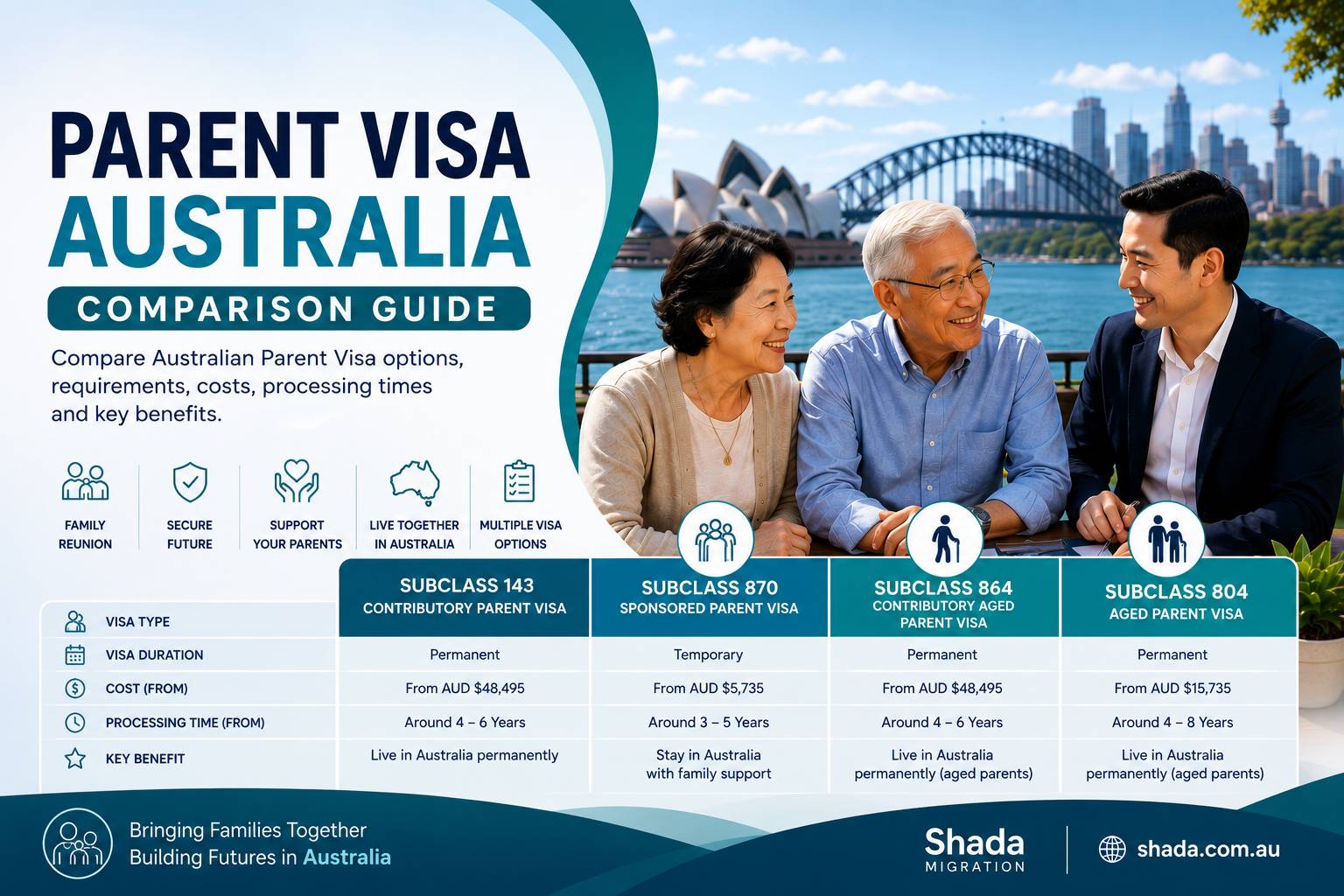
The Parent Visa Australia – Comparison Guide has been designed to help families understand the major Australian parent visa pathways and compare key eligibility requirements, costs, processing considerations and long-term migration outcomes.
Australia offers several parent visa options. The most suitable pathway depends on individual circumstances, family composition, sponsorship arrangements, age requirements and migration goals.
- Compare major parent visa subclasses
- Understand eligibility requirements
- Review sponsorship obligations
- Explore costs and financial considerations
- Identify suitable parent visa pathways
Parent Visa Overview
Parent visas allow eligible parents of Australian citizens, Australian permanent residents and eligible New Zealand citizens to spend extended periods in Australia or obtain permanent residence.
Some parent visa pathways are temporary, while others provide permanent residence. Certain visas require applicants to satisfy the Balance of Family Test, while others focus on sponsorship and financial support requirements.
Understanding the differences between the available pathways can help families make informed decisions and avoid pursuing a visa option that may not align with their circumstances.
Parent Visa Comparison Guide
The following comparison provides a general overview of Australia's most common parent visa pathways.
Subclass 143
Type: Permanent
Suitable for: Parents seeking permanent residence.
Balance of Family Test: Usually required.
Sponsorship: Required.
View GuideSubclass 870
Type: Temporary
Suitable for: Extended family visits.
Balance of Family Test: Not required.
Sponsorship: Required.
View GuideSubclass 864
Type: Permanent
Suitable for: Eligible aged parents.
Balance of Family Test: Usually required.
Sponsorship: Required.
View GuideSubclass 804
Type: Permanent
Suitable for: Eligible aged parents.
Balance of Family Test: Usually required.
Sponsorship: Required.
View GuideWhich Parent Visa May Be Suitable?
The most suitable parent visa pathway depends on a range of factors including age, sponsorship arrangements, family circumstances, migration objectives and eligibility requirements.
While some families prioritise permanent residence, others may prefer temporary options that allow parents to spend extended periods in Australia without pursuing permanent migration.
Families Seeking Permanent Residence
Contributory Parent Visa and Aged Parent Visa pathways may be appropriate for families seeking long-term settlement outcomes.
Families Seeking Temporary Stay Options
The Sponsored Parent Visa (Subclass 870) may provide a flexible option for extended family reunification without immediate permanent residence.
Parents Meeting Aged Parent Criteria
Aged Parent Visa pathways may offer additional options for applicants who satisfy the relevant age requirements.
Families Requiring Strategic Advice
Where multiple pathways appear available, professional migration advice may help identify the most suitable option.
Frequently Asked Questions
Which parent visa provides permanent residence in Australia?
Several parent visa pathways may provide permanent residence, including the Contributory Parent Visa and certain Aged Parent Visa subclasses, subject to eligibility requirements.
What is the main difference between the Subclass 143 and Subclass 870 visas?
The Subclass 143 visa is a permanent residence pathway, whereas the Subclass 870 visa is a temporary parent visa designed for extended stays in Australia.
Do all parent visas require the Balance of Family Test?
No. Some parent visa pathways require applicants to satisfy the Balance of Family Test, while others operate under different eligibility frameworks.
Can parents remain in Australia while a parent visa application is being processed?
The answer depends on the visa subclass, the applicant's circumstances and any visas held at the time of application.
What additional costs should families consider apart from government application charges?
Depending on the visa pathway, families may need to consider medical examinations, police clearances, translations, migration advice costs and Assurance of Support requirements.
Can parents apply if some of their children live outside Australia?
Possibly. Certain visa subclasses require applicants to satisfy the Balance of Family Test, which examines where children are ordinarily resident.
How do families determine which parent visa is most suitable?
Suitability depends on factors such as age, sponsorship eligibility, financial circumstances, migration goals and the family's preferred long-term outcome.
Reviewed by Principal Migration Consultant
This page has been reviewed by Mohammad Reza Azimi, Principal Migration Consultant at Shada Migration. Mohammad has assisted clients with Australian migration matters since 2009 and holds a Graduate Certificate in Migration Law from the Australian National University (ANU).
Need Help Comparing Parent Visa Options?
Choosing between different parent visa pathways can be challenging. Understanding eligibility requirements, sponsorship obligations, processing considerations and long-term migration outcomes may help families identify the most appropriate parent visa strategy.